The Myth of Political Neutrality
In a political climate that seems ready to erupt at any second, it only makes sense that politics is seeping out of its own realm into other areas of our lives. You often find people reminiscing about how‘back in the day’ politics and popular media were separate affairs, and while the truth of that observation is highly contested, what is clear is that politics is more present in the everyday than ever before. Social media, in particular, allows for the easy transmission of political thought;what previously would have been said through newspapers or speeches is now widely (and freely) available on our phones and computers. Not only does this make society more politically aware, it sets an expectation of greater political participation from those who have a platform.
Recently, this has manifested in the expectation for celebrities to use their platform for political activism. Some would say that this is a foolish thing to suggest; fame doesn’t signify any credentials in political thought, how can we expect these people to act as advocates for topics they may know nothing about? And this is true to an extent. Often, celebrities are not experts in current affairs, and so we shouldn’t expect them to be able to provide nuanced takes on every event that happens in the world. However, the luxury of apoliticality is scarce today, as political divisions seem sharper than ever. When silence is seen as complicity, simply saying ‘it’s too complicated’, or ‘I don’t know’ is no longer an option.
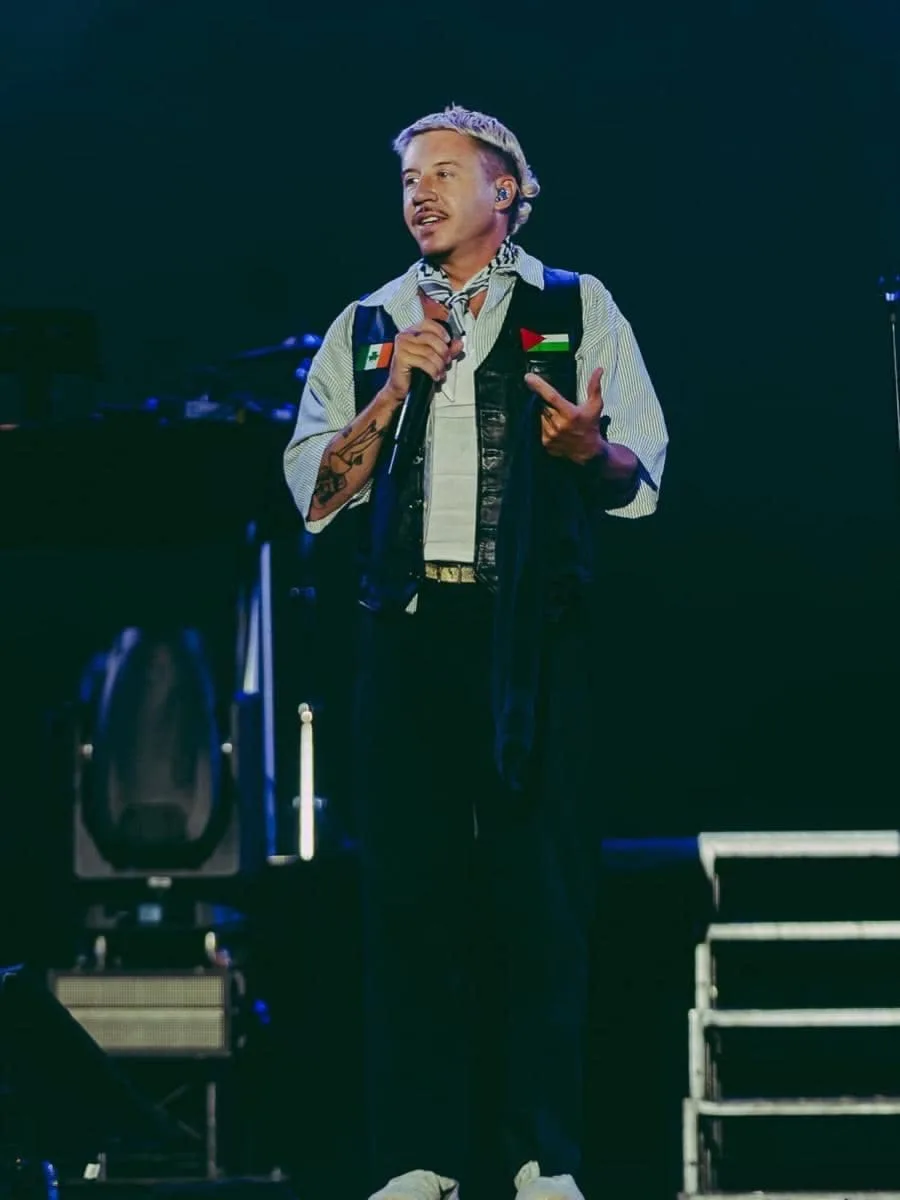
Recently, debates over the Ed Sheeran and Macklemore controversy have been all over social media. For those who aren’t familiar, during his opening act for Ed Sheeran’s Loop tour Macklemore dared to say the words ‘Free Palestine’ before performing his song ‘Hind’s Hall’. Following this, Macklemore was removed from Ed Sheeran’s tour due to backlash from stadium owners, who claimed that Sheeran would not be allowed to perform at the venue if Macklemore stayed onboard. Since then, all of Sheeran’s supporting acts have withdrawn out of solidarity with both Macklemore and the Palestinian people.
Since these incidents, Sheeran has claimed that he gave into the stadium owners’ demands because his music, and therefore his concerts, are apolitical. Now this begs the question: why bring on Macklemore in the first place? As a particularly outspoken activist, he embodies exactly what Sheeran claims he isn’t. So, by choosing Macklemore as an opening act, was Sheeran looking to reap the benefits of his activism without having to suffer any consequences himself? . This is a highly cynical view of events; maybe it was just that the two have performed together before and wanted to again. But it never hurts to ask the question.
Now, although this is not the only instance of a celebrity's claimed apoliticality being tested, I believe it provides a perfect example of why a supposedly ‘neutral’ stance doesn’t work. In a situation where Sheeran had to choose a side, to either bow down to the stadium owners or to support his opening act, he chose to side with the stadium owners. Sheeran’s choice to remove Macklemore was not apolitical - there was no apolitical option in this situation. What was shown was that when given the choice, Sheeran chose to act according to the status quo rather than taking a stand, protecting himself first and foremost. But nothing is truly apolitical. When one side is campaigning for change, whilst the other seeks to maintain the established order, neutrality often means seeking to maintain normality.
As the situation comes to a close, with Macklemore announcing his ‘Free Palestine’ tour and Sheeran bringing on a new opener, we come to ask what has come from this, and what can we learn from it? One takeaway is that activism, when coming from a privileged party like a celebrity, can in fact reap many benefits. Macklemore gained hundreds of thousands of followers over this, and was able to announce a charity tour for a good cause. However, we also learned that neutrality has far fewer consequences than X makes it seem: Sheeran was able to continue his tour, announce new acts, and with significant support from many mainstream media outlets.
So, can celebrities continue to be apolitical in our politically polarised world? That depends on where you draw the line of apoliticality. Can they act with self-proclaimed neutrality? Absolutely. However are those actions in fact apolitical? It doesn’t appear so.
By Jessica Thompson · posted 17 October 2026 · edited by Abbi Mcdonald The views expressed in this article are the author’s own, and may not reflect the opinions of N/A Magazine.