The Politics of Who We Listen To
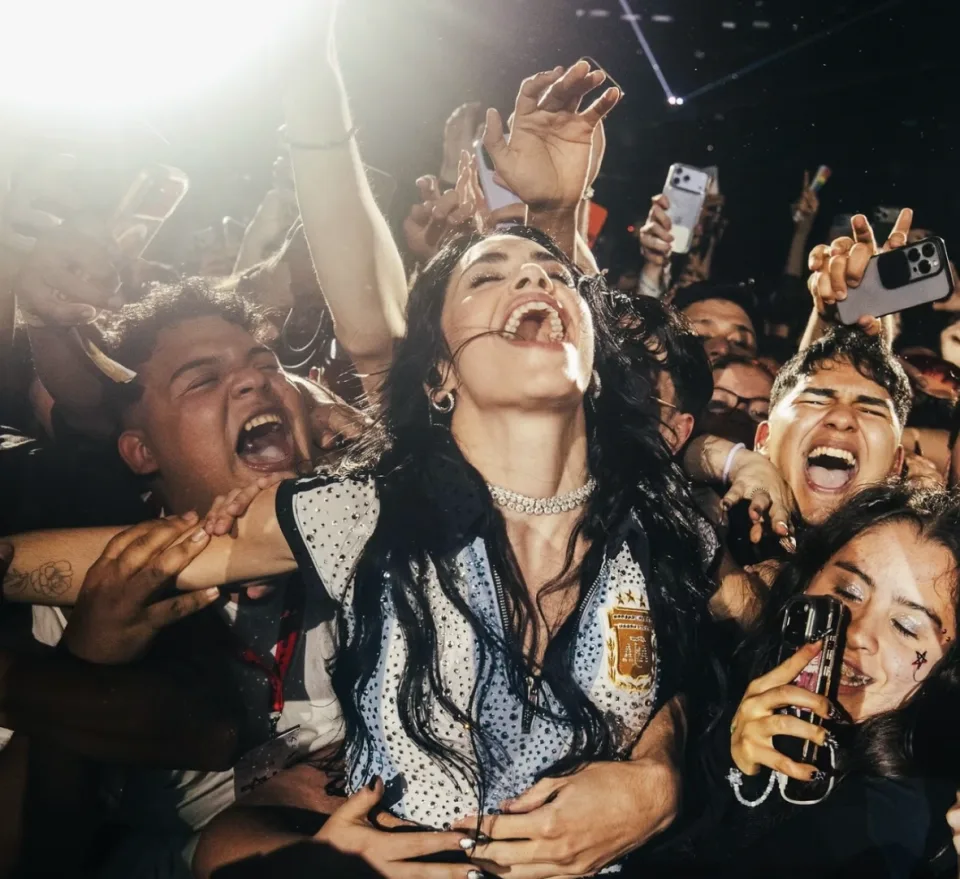
In the Argentine music industry, I’ve witnessed the emergence of a particular phenomenon. Lali is an actress, dancer, songwriter and pop singer. She starred in countless TV shows that an entire generation grew up watching. But as she got older, her career as a solo artist was never particularly remarkable. A song here and there that gained some recognition, the occasional local award. And yet, she went from filling a venue of just 8,000 people to, in one leap, playing a stadium for her very next show, and becoming the first Argentine woman to do so.
What, then, explains the sudden leap? Lali did not release an album that became an overnight hit. She did not go viral on TikTok. She did not befriend Hollywood stars. What happened was that she became embroiled in a very public clash with none other than the president of the country, who accused her of pocketing public funds through free cultural festivals. The artist did not have to waste her breath proving her innocence: in a single social media post, she simply reminded the public of her trajectory and the many years of hard work behind it.
And that was when something began to take shape. Lali started speaking out much more explicitly against the political right—the ruling party. Little by little, she began to resonate with a mass of people, especially young ones, in a movement that echoes the origins of rock: revolutionary, defiant, anti-establishment. Blessed too with charisma and eloquence, she has spoken out at every major political turning point, while also showing up at social demonstrations as just another citizen.
Lali forged such a strong connection with the public through her authenticity, self-expression, determination, humility and solidarity over shared causes. She was no longer just a pop singer; she was slowly becoming a symbol and a figure for younger generations to follow. What strikes me the most are her Spotify metrics. In 2025, she did not even rank among the 10 most-listened-to artists in the country, and yet she sold out two nights at the city’s biggest stadium, with a capacity of 85,000 people. The most-streamed Argentine female artist in the country did not come close to drawing a crowd of that size.
And that is precisely where the heart of the matter lies: people do not go to see her just for the music. Perhaps they do not even know most of her songs, given that her hits can be counted on one hand. Most of her music is youthful pop, centered around romance and self-discovery. And yet, people of every age and every corner of the country keep showing up because they feel part of the political and social phenomenon that she has come to represent.
Lali is just one example of what is happening across the music industry on a global scale. We see pop artists such as Zara Larsson, Lorde, Olivia Rodrigo, whose political stance is a fundamental part of their artistic (or personal) identity. Because what this makes us understand is that, as listeners, it is not just the music or the performance that moves us. We are drawn to what feels genuine; to humility, to social awareness. When a celebrity remains silent on issues of major social relevance, they are dismissed as “fence-sitters”. They lose depth and fall back into the dullness of being just a commercial product. Those who do not speak out—or those who do so in controversial ways against minority groups—face intense backlash and are cancelled.
Good music and catchy lyrics can only take an artist so far. We follow the people we follow because they resonate with us on a human and social level. They become icons whose ideas we share, and we give them back a scenario for those ideas to flourish. They are leaders, influencers. And, fortunately, they also make spectacular music. Lali finishes to frame her rebellious and controversial character by releasing “PAYASO”, a song openly mocking the president and his relentless fixation on her. Accompanied by a music video parodying the politician’s gestures, it would become one of the biggest musical milestones of her career, as well as the most iconic moment of her live shows. Mosh pits, roaring crowds, and a sea of people singing along, captured in a moment that can only be described as revolutionary.
By Sol Feldman · posted 17 October 2026 · edited by Beth Hodgson The views expressed in this article are the author’s own, and may not reflect the opinions of N/A Magazine.