Opinion Pieces Season 6, Issue 1
Weaving Out of Orbit
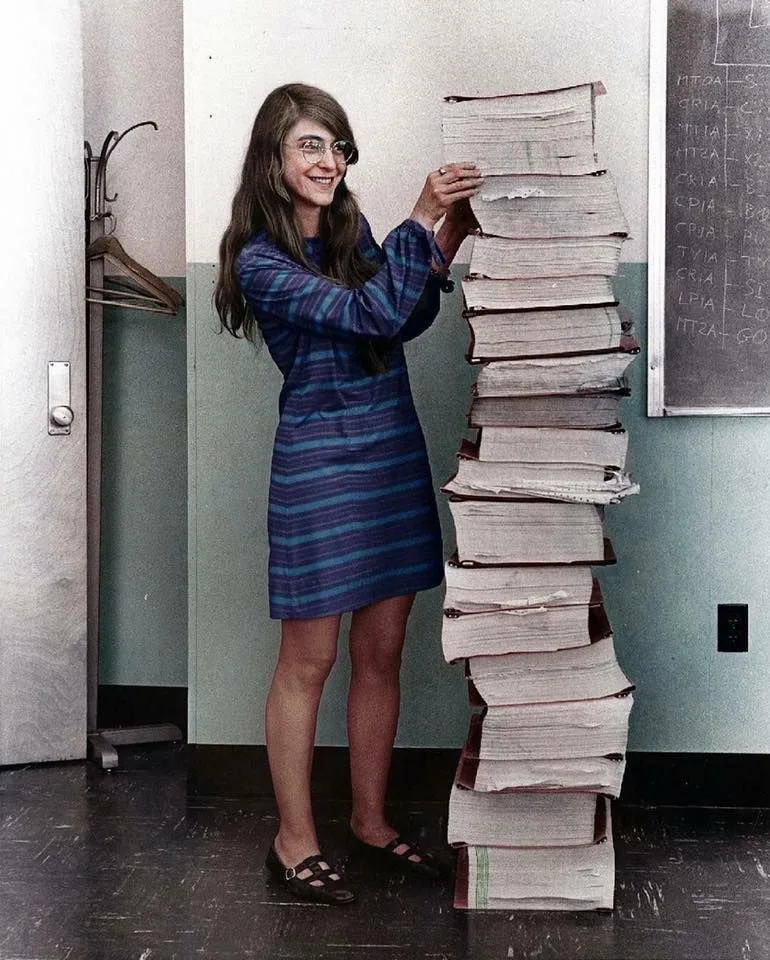
This article comes in the advent of the very recent death of Margaret Hamilton, one of the most historically important software engineers in the world’s history. On October 8th, 2026, news circulated officially confirming her death at age 90. Her legacy now, as it has been for quite a few decades, is the success of the Apollo 11 mission carried out by NASA in 1969, due to her emphasis on software rather than hardware in its technology.
The very reason her software technology worked so well was thanks to her team members; the LOL, Little Old Ladies workforce. They created the braided code necessary to put the United States at the forefront of the 20th century space race as we know it. This team, mostly consisting of women, worked out of a factory in Boston during the Apollo 11 mission to complete storage-minimizing data chains that would prioritize the safety of the astronauts on the Moon over administrative, regular routine errors throughout the mission’s duration. In other words, their software was intentionally, and innovately, built to prioritize humane operations over those of the government.
This shows the importance of empathy and the recognition of the human condition in the age of technological hegemony. What Margaret Hamilton and her LOL team pioneered was more than a method for data storage in a convoluted period of global political tension, instead an influential moral decision on the creation of historical technology for the future. If one looks back at the transcriptions that the LOL team used to understand code and bugs in their work, mysterious acronyms are found that are practically impossible to decode by any scientific means. As it turns out, ‘FLTs’ and ‘Auge Kugel’ meant ‘Funny Little Things’ (bugs) and ‘eyeball’ in German. Bringing a bit of joy to the creation of these technological feats grounds people and forces us to revisit one question again and again: what are we doing all of this for?
To answer that, I will be using the most unofficial method possible since I am not a professional astrophysicist, software engineer, or even a university student enrolled in the sciences. I will be thinking about the braiding of those strings of data that the LOL women used for their work. I will be thinking of the importance they placed on the fact that safety mechanisms for the astronauts were more important than the objective lunar landing in itself. Their work was, and is today, inherently an art form crudely forgotten in the name of engineering efforts. Choosing humanity will forever be the most dedicated art one can labor for. Braiding is only one facet of this legacy.
Hair braiding as a form of art has cultural continuity beyond most types of self expression in the world. It is also culturally globalized, spanning centuries of human ecology. It has been a symbol of cultural expression, revolution and resistance, and protective plaiting since humans first began operating within a vacuum (earth itself). It is one of the only forms of art that, despite being ripped from its cultural contexts to be of objective use to the masculinized system of capitalist production, has survived in its artistic origins. It has always survived, and continues to aid technological advancement because of it. The braiding of any textile has long been a task designated to women in communities. It has also, coincidentally, long been a practice necessary for survival; fish nets, basket weaving and building tethers are only some of the examples that come to mind. However, even with all the existential saving of humanity involved, braiding has always been seen as a soft skill (and therefore lesser than). This attitude towards ‘soft skills’ that has long been an element of western societies has been more detrimental to our own survival than we can ever imagine.
This discussion comes at the climax of human technology being used for the inevitable; the continuation of the space race that existed 50 years ago. Just a few days ago, it was made public that global hegemons are fighting for the ability to have nuclear reactors on the moon. Lunar control and space travel have never been more prevalent to the political and cultural discussions surrounding the human race. Therefore, an examination of these exploratory origins can help us understand exactly where the cultural origins of our technology must be favored in the future over artificial technological developments (which might be otherwise cost efficient).
So why do these technological developments get prioritized throughout decades upon decades of administrative, cultural, societal change? Why do our governments funnel billions every year to the goal of laying claim to space? Certainly, it has to be because of humanity itself, one would think. To allow the survival of the human race, and to honor its legacies. Because the dreams of the people sending these machines out of orbit is to honor the legacy of all humans; to survive beyond ourselves in art, music, and the essence of our own souls. After all, this is why the Golden Record exists; to cherish the essence and soul of the history of humanity on Earth. The record itself was filled with languages spoken around the globe, with images of people dancing and scenery across Earth under orbit; it celebrated all the emotional parts of being a human being in our current time, and it was only successful in its sending because it was spearheaded 40 years ago. The romanticization of all the beauty in space exploration through government funding has since faded, and I personally believe the Golden Record would never have been able to have had any success today, for the sole reason it does not prioritize profit and technological progress as its sole goal in its invention.
Today, all modern spacecrafts and satellites have abandoned core rope memory use (braiding of code) in favor of lighter, more dynamic code processing methods. They are, undeniably, much more useful for the reasons we send up lunar probes now; to collect data efficiently and be able to evolve technology more rapidly than we have ever seen possible. This is why so many space exploration projects prioritize cost efficient, unmanned, abandonable probes, because they are made for data collection and data collection only. The privatization of orbiting satellites specifically has begun its own horrid, inhumane space-race era in the past few years as well. SpaceX, owned by Elon Musk, has set the tone for erratic, unmitigated space control with his Starlink satellites which began to be put into Earth’s orbit in 2019. His machines are polluting and run simply for the purpose of profit. These profit-driven, colonialized ideas of how space can become our own land is exactly why western hegemons have announced colonial nuclear reactors to be put in place through lunar missions. Because we as a people have lost our answer to the initial question driving this exploration; what are we doing all of this for? These machines are cold and inhuman, and will cease to mean anything but that of political leverage if we do not look back at our roots.
Unlike these privatized advancements today, select old Voyager probes built almost 50 years ago are still floating around the Milky Way today on the original braided code artistically inspired and almost certainly following the minds of our LOL team so many years ago. These historical probes are relied upon for photos and data collection so far in our solar system that no modern software and hardware development could possibly catch up. These braids of code, although butchered and outdated, tell our human story, they tell the story of years of dedication and the resolution that the people matter more than the machines they build.
I was inspired originally to write this article because of Artemis II’s mission in early April of this year, whose team included the first woman ever to travel into space beyond a lower point near earth’s orbital zone. Christina Koch, the astronaut, wore tight braids while on the journey towards the moon, with a photograph posted to the public of her looking out at Earth from the Artemis II with two braids in her hair. The photo was not only historic for including the first woman ever to go beyond Earth’s orbit, but also because of its cultural implications. As soon as I saw this photo, I was immediately reminded of Margaret Hamilton, of the LOL team, of all the women in the world who have relied upon woven stories to endure their legacy.
This legacy, the one of braids and care and love for science and life that is created from it, was finally being given the chance to stand on its own. Because after all, the whole point of space exploration was to continue the legacy of humanity. And who better to honor in this legacy than the women who were weaving its through-line. Margaret Hamilton has passed, and for all I know she never found out of the plans to colonize, inhabit, and inevitably extract from the moon any items that make it lunar in its own right.
These braided legacies overlap through time and space to create one singular moment where we can possibly even conceive the idea of our own creations making it to the moon, and this concept should never be taken for granted. Margaret Hamilton, Christina Koch, and the LOL Team have created the legacy of humanity in space all with woven hair and metal. I look forward to watching as the next woman in braids leads Earth’s next mission beyond orbit.
By Maya Mason · posted 17 October 2026 · edited by Joseph Wear The views expressed in this article are the author’s own, and may not reflect the opinions of N/A Magazine.